Experimentation and reflection: an example of an auto-ethnographic case study
The purpose of this article is to demonstrate an example of an auto-ethnographic experiment, how it can be set up, some insights in how such a proces could be - at least how it works for myself - and some ideas about questioning and reflection.
My ongoing research questions how piano approaches and harmonic concepts can contribute to the harmonic language of an accordionist. The aim of this experiment is ‘translate’ a composition of Jeroen van Vliet (left-hand comping pattern with a right-hand melody) to the accordion. While working on this material many questions pop-up; can everything be played on the accordion? What does that technically mean? And even when I exactly copy Jeroen’s version on the accordion, what does that musically mean considering the differences in sound between a piano and accordion? How autonomous can both of my hands be? What does a left-hand comping pattern like this mean for the phrasing of the melody?
While I step by step adapt the copied piano sound to something that fits the accordion better, I gain many insights about the characteristics of an accordion’s sound within this specific type of music. Eventually I hope to discover, through piano concepts like this one, new approach to harmony on the accordion.
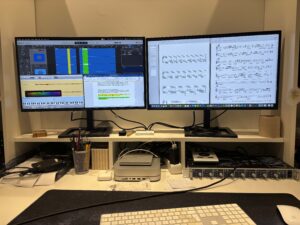
The setup is as follows: On the computer I have my DAW opened (top left screen), the original recording (left screen bottom left), a word-file as notebook (left screen bottom right), the transcription I made of the original recording (right screen left) and the lead sheet (right screen right).
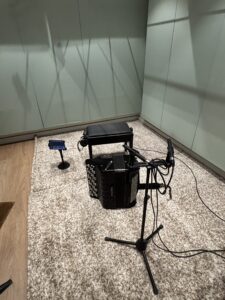
And behind me the recording setup with mics, the accordion and an iPad to remotely control the DAW. As these details might seem unimportant, for me clarity and overview is absolutely important. Performing, analyzing and thinking about everything you do, feel and hear during the experiment is already so much, that I don’t want to be distracted by practicalities that I am able to tackle by a proper setup.
As I perform bit by bit (like a bar, a few bars, a single pattern etc) I jot down all thoughts I have at that moment; how it feels, what I think sounds good, technicalities of the performance that are of importance, new questions that arise etc. Also, I sometimes record my observations by voice while I am recording whenever I don’t want to interrupt my playing that much (stand up, walk to the computer, walk back to the piano stool etc). In this way I create a logbook with observations, questions, thoughts, ToDo’s etc. While listening back to recordings I already cut and select the good ones and mark them with a color that corresponds with the colors in my word-file. As an experiment like this (a theme of 40 bars) results in 30 minutes of recordings, I want to be able to search quickly through the material. And of course, during the proces everything is clear in your mind, but after a day or more you probably loose overview of all the material. Every new ‘question’ is numbered and every well performed ‘answer’ is colored (see DAW and Word-file in first photo). So, I might end up with the recordings 1yellow, 1blue and 1 purple, that corresponds with a legato, an more accentuated and a portato version of a particular phrase that corresponds with the first question that I explored.
All new questions that emerge during the proces I directly write down. I don’t want to drift away during the proces, so sometimes I leave them where they are. In a later stage I am always able to reflect deeper on the material when necessary and pick up the question. And whenever I stop, I always try to stop with a new question. As starting is always a tricky thing, it is easier when I can start the next day with a question that I already posed while I was in the middle of the proces. And when this question is ‘answered’, I probably have three new ones to continu with. In this way I can start and stop whenever I want – at least, when I can leave my setup as it is.
At some point, I start a new document to analyse my proces. While I go step by step through the recordings, I elaborate on the meaning of the different versions. How does it feel? How do the different layers function on the accordion? How does an approach like this relate to the accordion? How does an approach like this relate to improvisation – so, how adaptive can I perform? And how does it relate to myself, my skills, my habits? This part of the proces is to structure the recorded material, reflect on its direct outcome and, hopefully, reflect on a meta-level what it means for the instrument, or myself as a performer. It aims to result in a well documented text in which notated music and musical examples of the original and my recordings are alternated with text.
Relating this experiment to the Rheinberger-model (the triangle of Experimentation, Reflection and Information), this experiment is a back and forth between Experimentation and Reflection. This is an example of an auto-ethnographic research – through personal experience of the transformational proces of the music, insights on broader musical phenomena and practices are gained. Note that this last step – gaining insights that go beyond your own observatorions and connect to bigger topics – is essential for a qualitatively well-executed research. Otherwise is will remain a proces description, alternated with some personal opinions. Perhaps there is a necessity to include external information whenever you hit a topic that needs contextualisation. In that case, you will have the full Rheinberger-model included.
In my mind (at this stage of the proces) I have to tackle two tasks; firstly, to ‘copy’ the piano recording as closely as possible and elaborate on technicalities, musical parameters (e.g., flow, rhythm, transparancy, balance), musical meaning (i.e., how well does the result sound?) and possible implementations (i.e., when would a concept like this work well and why?), and secondly, take the step to actually ‘transform’ the copy into something that goes beyond a piano and an accordion sound.
This last step needs another approach. I take something from the concept to focus on and implement it in a way that I am feeling comfortable with. For instance, I take the 2-part voicings that Jeroen used and perform the tune with 2-part voicings in a way that is common for the accordion. So, I’ll change the pattern (i.e., play only chords between melodic phrases and not in a fixed comping pattern) and use the new voicings (i.e., on the accordion’s Standard Bass only fixed 3-part inversions are possible, while these 2-part voicings need a left-hand system that commonly isn’t used in jazz music). The result is something in between the original and traditional; timing and placement of the harmony is traditional, while the sound of the harmony itself is original, new and exciting. This result is in the end musically more rewarding as a ‘copy’ that doesn’t have to impact I wish for.
Whenever, after this experiment (or in a later stage of my research), I might think of other possible ways to use Jeroen’s techniques, I can always record those and add them to this experiment. If not, then this experiment is finished and I will continu doing the same thing with another piano recording.
So, to create an overview, the methodology for this experiment was:
1) choose a recording with an interesting feature that is new for the accordion
2) transcribe the recording
3) analyse the recording – what parts are interesting for me?
4) record bits of the original in different ways – question the possibilities
5) log the findings – in a notebook and voice-recordings
6) phrase new questions along the way in order to dive deeper into the material and possibilities
7) elaborate on the outcomes through different perspectives – from technical, musical and contextual viewpoint
8) pick new elements from this approach and merge them with traditional practices in order to transcends both the piano and the accordion’s current practice.
RC, 10-9-2025